Global Entry Credit Tracker: From Application Fee to Statement Credit
A practical Global Entry credit tracker for card eligibility, application-fee charges, reimbursement timing, missing credits, and renewal reminders.
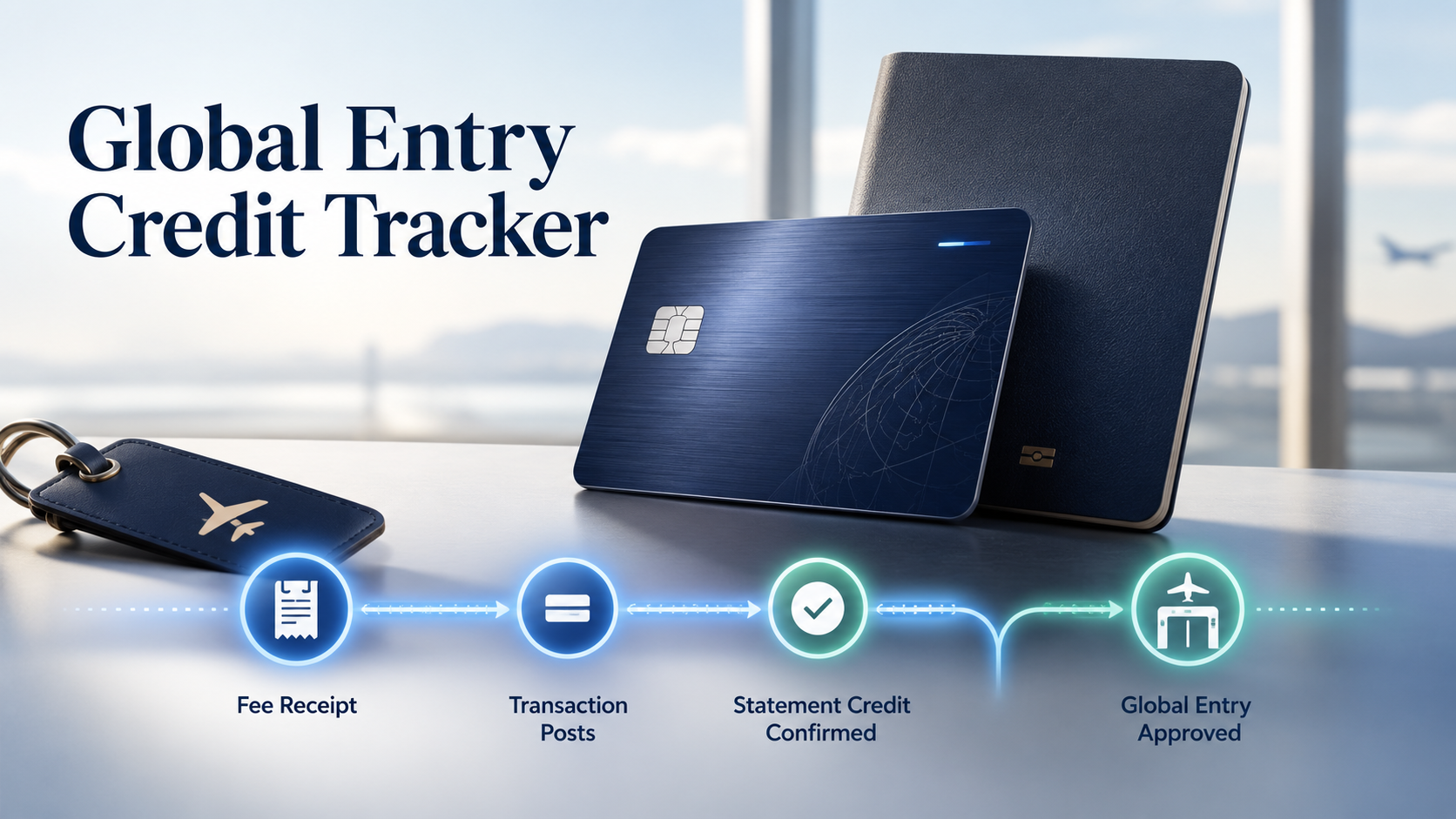
TL;DR
Track the card reimbursement separately from the Global Entry application.
- Track the card reimbursement separately from the Global Entry application.
- Start the issuer follow-up clock from the posted fee charge, not the pending transaction.
- Verify the exact card's current benefit cycle before paying for any applicant.
- Record the statement credit only when it actually posts.
Track two timelines, not one
The first timeline belongs to the card:
1. Benefit eligibility checked.
2. Application or renewal fee submitted.
3. Card charge pending.
4. Card charge posted.
5. Statement credit pending.
6. Statement credit posted—or issuer follow-up needed.
The second timeline belongs to the traveler:
1. Application or renewal submitted.
2. Application under review.
3. Conditional approval or another program update.
4. Interview or other required step.
5. Membership approved, renewed, or otherwise resolved.
Do not mark the card credit “complete” because the traveler received conditional approval. Likewise, do not assume a posted statement credit means the application was approved. The issuer is evaluating an eligible card transaction; the government program is evaluating the traveler.
This distinction matters when application review takes longer than expected. The tracker should still show whether the card reimbursement arrived on time, even if the traveler has no new application update.
What to verify before paying the fee
Use the issuer’s current benefit guide or authenticated benefits page for the exact card, then record a short “checked on” note. Confirm:
Then check the current application instructions and fee in the official Trusted Traveler Programs portal. A familiar card benefit does not freeze the government fee or issuer rules.
If you are paying for a spouse, partner, or another family member, verify the card’s terms first. Some benefits are triggered by the first eligible fee charged to the account, but that does not create a universal rule for every issuer or card.
- the account currently includes a Trusted Traveler Program fee credit;
- Global Entry applications or renewals are eligible;
- which other programs share the same credit;
- the current reimbursement cap and benefit frequency;
- whether the benefit is per account, per card, or described another way;
- whether an earlier charge by the primary cardholder or another user may have consumed the cycle;
- which card must be used for the application fee;
- the issuer’s stated posting window;
- whether the account must remain open and in good standing for fulfillment.
Fields for a Global Entry credit tracker
| Category | What to record | Why it matters |
|---|---|---|
| Card label | A private label such as “travel card ending 42” | Identifies the benefit without storing a full card number |
| Benefit terms checked | Source and date checked | Makes stale assumptions visible |
| Last known credit use | Date or “not found—verify” | Helps detect a multi-year cycle already consumed |
| Applicant label | Self, spouse, partner, or family member | Prevents two people from planning around the same credit |
| Program | Global Entry, renewal, or another verified eligible program | Shared benefits may be consumed by the first eligible charge |
| Fee submitted | Transaction date | Starts the payment record |
| Charge posted | Posted date and statement period | A pending transaction is not the same as a posted charge |
| Follow-up date | Based on the issuer’s current stated window | Creates an evidence-based reminder |
| Credit posted | Date and amount actually credited | Proves the reimbursement happened |
| Card-credit status | Planned, charged, posted, credited, or needs follow-up | Shows the next card-side action |
| Application status | Submitted, under review, conditionally approved, interview needed, or complete | Keeps the traveler-side process separate |
| Renewal reminder | A date based on current program and card terms | Preserves the next decision without assuming a fixed cycle |
Use one row for each application-fee charge.
Do not store a PASSID, Known Traveler Number, application number, full card number, login, or identity-document image in a general benefits tracker. Keep sensitive application details in the official account or another secure system.
Use a status flow that catches missing credits
A single “used” checkbox hides the most common failure: the card was charged, but nobody returned to confirm the offset.
Use these card-credit statuses:
Only move a row to Credited after the credit appears in card activity or on a statement. An in-app progress meter, support estimate, or application approval is useful evidence, but it is not the reimbursement itself.
- Planned: The benefit appears available, but no payment has been made.
- Charged—pending: The fee was submitted and the card transaction is still pending.
- Charge posted—credit pending: The fee appears as a posted transaction, but no matching statement credit is visible.
- Credited: The statement credit is posted and matches the eligible reimbursement you expected.
- Needs verification: The current benefit terms, previous use, or selected card are uncertain.
- Issuer follow-up: The issuer’s stated window has passed and the credit is still missing.
- Not eligible or not reimbursed: The issuer confirmed the charge does not qualify, or the benefit cycle was already used.
A concrete household scenario
Maya and Jordan both need renewals. Their household has two travel cards that may include Trusted Traveler Program credits.
Before either person pays, Maya checks the current benefit guide for each card. She finds the last statement credit on Card A, records its posted date, and marks its next eligibility as “verify with issuer” instead of calculating a date from memory. Card B shows no known use, but she still records the date she checked the benefit.
Jordan’s fee is paid first with Card B. Maya records:
Two days later, the charge posts, so she changes only the card-credit status to Charge posted—credit pending. Jordan’s application remains Submitted. When the statement credit appears, she records its posted date and changes the card side to Credited. She does not change the application status until the official Trusted Traveler Programs account changes.
This prevents three mistakes: assuming Card A is ready again, spending both credits on one applicant, and treating reimbursement as proof of approval.
- applicant: Jordan;
- program: Global Entry renewal;
- fee submitted: July 28;
- charge status: pending;
- follow-up: based on Card B’s current stated posting window;
- application status: submitted.
Why a Global Entry statement credit may not post
The traveler selected a default wallet card or a different physical card at checkout. Compare the posted transaction with the exact eligible account.
An earlier Global Entry, TSA PreCheck, NEXUS, or other eligible program charge may have consumed a shared credit. Search prior statements and check whether another account user made the first eligible transaction.
Issuer timing generally starts from a posted eligible transaction, not the moment the application button was clicked. Record the posted date before starting the follow-up clock.
The traveler sees “conditionally approved” and assumes the reimbursement is finished. Check card activity for a separate statement-credit line.
A benefits dashboard can update before or after the actual statement credit. Treat the posted card transaction and posted credit as the source of truth for the reimbursement record.
Card benefits change, product versions differ, and similar card names can have different terms. Reopen the current benefit guide for the exact account.
The fee posted, but the reminder was tied to the application interview instead of the issuer’s credit window. Create a card-specific follow-up date as soon as the charge posts.
What to do when the credit is late
First, use the issuer’s current stated timeframe—not a forum average.
Then collect a small evidence bundle:
1. the exact eligible card account;
2. the date the fee charge posted;
3. the transaction description and statement period;
4. the current card benefit terms and the date you checked them;
5. any earlier Trusted Traveler Program credit found on the account;
6. whether another user made an earlier eligible charge.
If the stated window has passed, use the support channel on the back of the card or in the authenticated account. Ask whether the posted transaction was recognized as eligible and whether the benefit cycle had already been used. Avoid sending application IDs or identity documents unless the official support process specifically requires them.
Keep the status at Issuer follow-up until the credit posts or the issuer gives a final eligibility answer. Record the outcome so the annual-fee review reflects realized value, not an expected reimbursement.
Connect the credit to reminders and renewal value
A multi-year benefit is easy to forget because it does not reset with a monthly or annual routine. Add two kinds of reminders:
Do not hard-code the next credit date from a generic four- or five-year assumption. Different products may define the cycle differently, and benefits can change. The reminder should tell you to verify, not promise that the credit has reset.
Use Perkmon’s credit card benefit calendar to keep the follow-up date visible alongside shorter monthly and annual benefits. The credit card benefits tracker checklist provides a broader setup for status, proof, and reset rules.
When the card’s annual fee comes due, count the Global Entry credit only if it actually posted and only at the value it delivered to your household. The premium travel card annual-fee review can help combine that realized value with other credits and benefits.
- a near-term reminder based on the issuer’s stated credit-posting window;
- a long-term “verify eligibility” reminder before the next application or renewal.
Where Perkmon fits
Perkmon can act as the reminder and status layer between the issuer account and the official Trusted Traveler Programs account.
Use the issuer as the source of truth for card eligibility, cycle rules, and the posted statement credit. Use the official program account as the source of truth for the application. Use Perkmon to remember:
That workflow does not require a bank login or sensitive traveler identifiers. It requires a few dates, a clear status, and a reminder tied to the right source.
- which card benefit you verified;
- who the planned fee is for;
- when the charge posted;
- when to check for the credit;
- whether issuer follow-up is needed;
- when to verify eligibility again before a future renewal.
Keep exploring
Frequently asked questions
How long does a Global Entry credit take to post?
Use the timeframe in the current benefit terms for your exact card. Start from the date the eligible charge posts, then contact the issuer if its stated window passes without a credit.
How do I track a Global Entry statement credit?
Record the eligible card, benefit-terms check date, applicant label, fee transaction date, charge posted date, issuer follow-up date, and statement-credit posted date. Track the application separately.
Can I use my Global Entry credit for someone else?
It depends on the exact card terms. Some account-level benefits apply to the first eligible application-fee charge, but primary and additional card rules vary.
Does a Global Entry credit work for renewals?
Many card benefits include an eligible renewal fee, but coverage is product-specific. Check the current benefit guide and confirm that the benefit cycle is available.
Why did my Global Entry credit not post?
Check whether the right card paid, an earlier transaction consumed the cycle, the fee charge has posted, the program is eligible, and the issuer's stated window has passed.
Does the statement credit mean my Global Entry application was approved?
No. The statement credit is a card-benefit reimbursement, while the government program handles the application. Track the two outcomes separately.
What should I do if the application fee is not visible on my card?
Check the official program's payment history and the selected card's pending and posted activity. Confirm which payment method was used before treating it as a reimbursement failure.
Before you act
- Credit card benefits, eligible Trusted Traveler Programs, reimbursement caps, cycle rules, application fees, account requirements, and posting timelines can change.
- Verify current terms for your exact card and current instructions in the official Trusted Traveler Programs portal before paying a fee or relying on reimbursement.
- This article is informational only and is not financial, legal, tax, immigration, or travel advice.
Turn this into a repeatable workflow
Perkmon is built for the operational side of credit card perks: what is still available, what has already been used, and what needs attention before value disappears.